Why CSL Sonic Logging Shows False Defects in Bangkok Bored Piles: The Acoustic Tube Debonding Trap
The high stakes of CSL anomaly alerts on Bangkok job sites
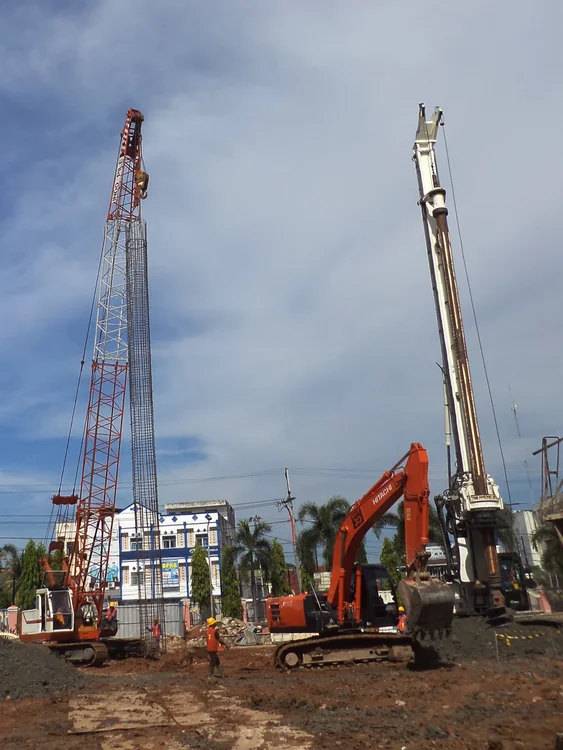
In Bangkok's high-rise building and transit infrastructure sectors, large-diameter wet-process bored piles (1.0 m to 1.8 m diameter) installed through thick soft marine clay into deep sand layers are standard practice. To verify concrete shaft integrity, structural specifications and supervising consulting engineers (วิศวกรที่ปรึกษา) routinely mandate Cross-Hole Sonic Logging (CSL) in accordance with ASTM D6760 on 100% of major foundation elements.
A severe anomaly on a CSL waterfall plot—characterized by a First Arrival Time (FAT) increase exceeding 20% and relative energy reduction greater than 20 dB—immediately triggers stop-work notices, dispute between general contractors and piling subcontractors, and costly non-destructive testing debates. However, experienced foundation engineers in Thailand recognize that a substantial fraction of reported CSL defects are acoustic artifacts caused by tube debonding rather than compromised structural concrete.
The physics of tube debonding: Hydration heat and differential contraction
Cross-Hole Sonic Logging measures the propagation time and energy of high-frequency ultrasonic compressional waves (typically 40 to 60 kHz) transmitted through water-filled steel or PVC tubes cast inside the pile. For acoustic energy to enter and exit the concrete matrix, intimate acoustic coupling must exist between the tube wall and the surrounding concrete paste.
In large-diameter Bangkok bored piles, the high volume of tremie-placed concrete (often 40 to 80 cubic meters per shaft) generates intense cement hydration heat, with core temperatures frequently peaking above 65°C to 75°C within the first 24 to 48 hours. During this thermal expansion phase, the steel access tubes expand alongside the setting concrete. As the shaft cools toward ambient groundwater temperature, steel and concrete contract at different rates due to thermal coefficient mismatch (steel expands and contracts approximately 20% faster than limestone or siliceous aggregate concrete).
Combined with autogenous and drying micro-shrinkage of the cement matrix, this differential contraction causes a microscopic annular detachment—debonding—along the external perimeter of the steel tube. Because the acoustic impedance of an air or moisture film is negligible compared to steel (approximately 0.0004 vs. 46 MRayl), ultrasonic energy cannot bridge the gap. The wave is forced to travel around the detachment or through delayed secondary diffraction paths, producing artificial transit delays and energy dropoffs that mimic genuine honeycombing or soil inclusions.
Multi-path geometric analysis: Pinpointing the suspect tube
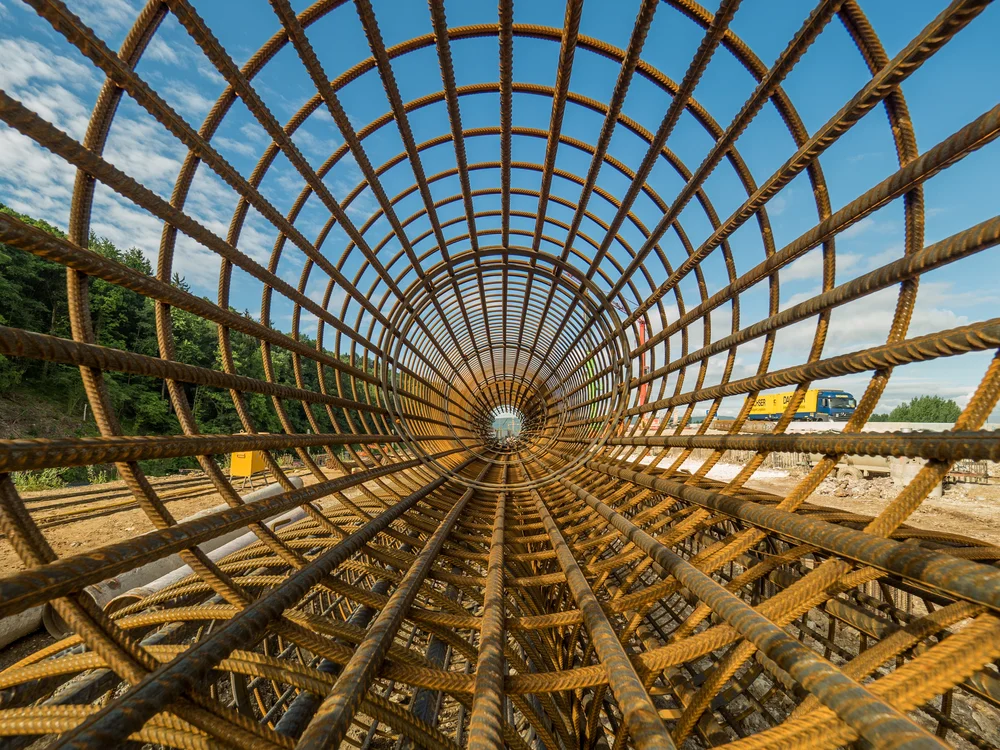
The most definitive non-invasive method to distinguish acoustic tube debonding from a real concrete void is multi-path geometric matrix analysis. A typical 1.2 m to 1.5 m diameter pile contains 4 acoustic tubes, creating 6 independent testing profiles (4 perimeter paths: 1-2, 2-3, 3-4, 4-1; and 2 diagonal paths: 1-3, 2-4).
If a true concrete defect exists within the pile shaft—such as bentonite cake entrapment, necking, or a cold joint—the acoustic anomaly will register across multiple intersecting paths that traverse the affected physical zone (for example, paths 1-2, 1-3, and 2-4 will all show delays corresponding to the localized inclusion).
Conversely, if tube debonding has occurred around a single tube (e.g., Tube 2), anomalies will appear exclusively on every profile connected to Tube 2 (Path 1-2, Path 2-3, and Diagonal 2-4). Crucially, all independent paths that do not involve Tube 2 (such as Path 3-4 and Path 4-1, as well as Diagonal 1-3) will exhibit completely normal wave speed (3,800 to 4,200 m/s), sharp first arrival times, and full signal amplitude at the identical depth. This geometric signature proves that the concrete core between the remaining tubes is structurally sound.
Diagnostic confirmation: Water pressurization, tomography, and coring
When multi-path analysis indicates isolated tube debonding, Thai testing engineers and project managers should implement an escalating diagnostic verification sequence before ordering destructive remedial action:
First, apply water-head pressurization or tube re-coupling. In cases where partial debonding is exacerbated by loose water coupling or minor air pockets, topping off the tubes with clean, air-free water and allowing hydrostatic pressure to equalize can re-establish acoustic contact. High-frequency re-logging after 24 hours often demonstrates signal recovery.
Second, perform 3D Ultrasonic Cross-Hole Tomography (CSLT). Tomographic mathematical inversion maps the spatial distribution of wave speed across the pile horizontal cross-section. In debonding scenarios, velocity degradation concentrates tightly as a narrow annular ring directly hugging the tube boundary, while the central concrete mass retains pristine high velocities (>4,000 m/s).
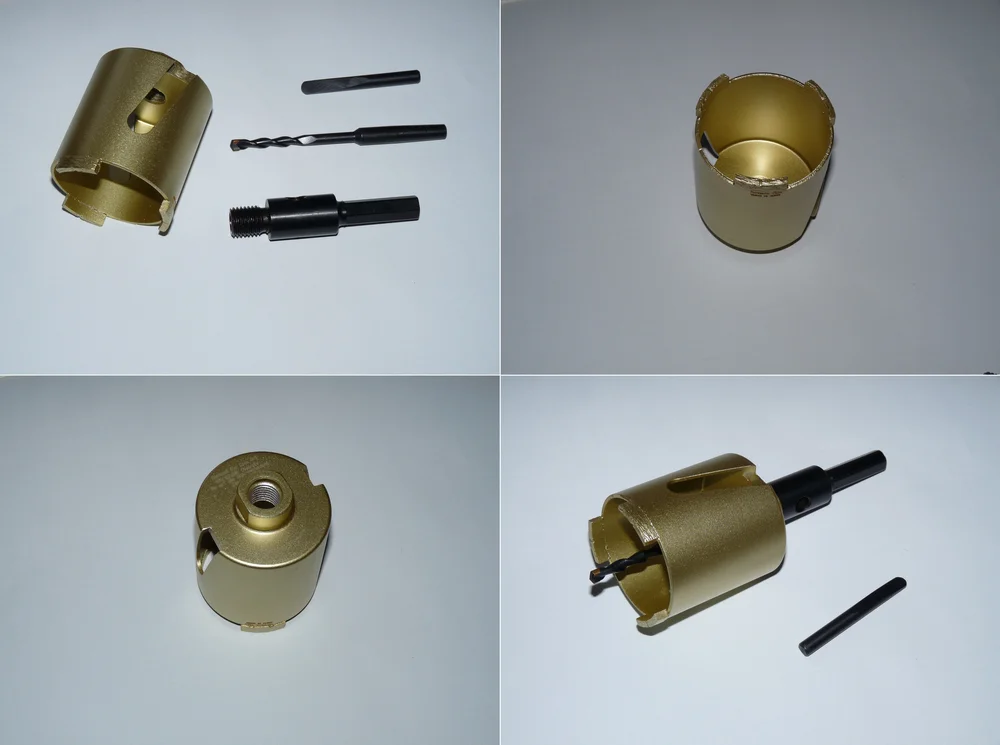
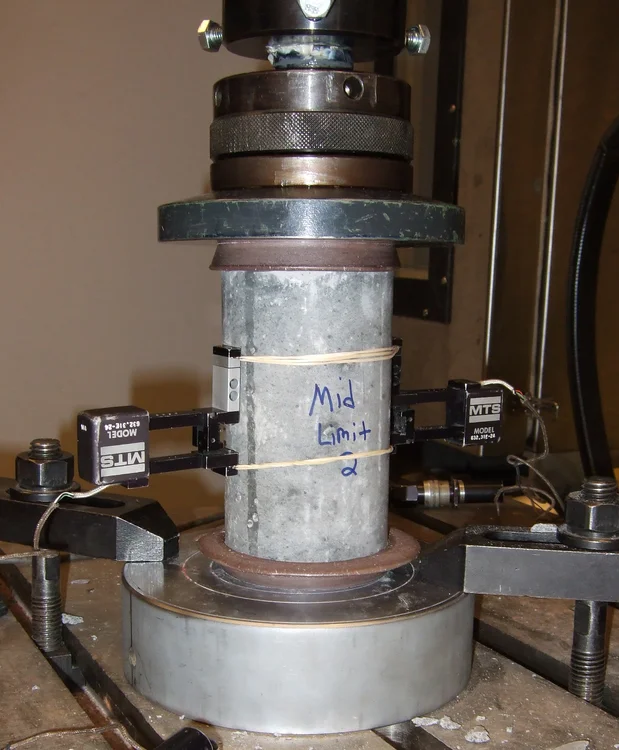
Third, if consulting engineers require physical verification under Thai engineering standards (EIT / ว.ส.ท.), conduct targeted rotary diamond core drilling (ASTM C42 / ASTM D2113). Rather than coring down the entire 50-meter shaft length, coring is focused directly within the disputed elevation adjacent to the suspect tube. Compressive strength testing of extracted cylindrical cores provides conclusive legal and contractual evidence to close the defect alert.
Contractual protocol for Thai site engineers and owners
To avoid costly disputes and project delays, project owners and contractors operating in Thailand should establish clear CSL evaluation protocols in the project foundation specification prior to breaking ground. Standard ASTM D6760 notes that an anomaly does not automatically constitute a structural defect; it requires evaluation by a qualified geotechnical or materials specialist.
Never accept a preliminary CSL field report as grounds for immediate pile rejection without multi-path analysis and water-coupling verification. When debonding is suspected, request the testing agency provide raw signal traces (waterfall logs, individual transit time records, and frequency spectra) for independent engineering review.
AN-THAI Engineering provides independent foundation integrity test evaluation, CSL log re-interpretation, and site QA advisory services across Greater Bangkok and Eastern Economic Corridor (EEC) industrial sites. We help project teams differentiate genuine geotechnical defects from acoustic measurement anomalies, safeguarding project schedules and structural integrity.
Frequently asked questions
Why does tube debonding occur more frequently in steel tubes than PVC tubes?
Black steel access tubes have a higher thermal conductivity and undergo significant expansion during the concrete hydration peak. When the core cools, differential thermal contraction between rigid steel and the hardening cement paste creates micro-gaps. PVC tubes have lower thermal conductivity, but PVC can deform under hydration heat or fail to bond mechanically with concrete if contaminated by drilling fluid.
How does an engineer differentiate tube debonding from bentonite slurry contamination?
Bentonite contamination or slurry inclusion forms a physical zone within the concrete body that spans across multiple acoustic paths intersecting that location. Tube debonding is strictly localized to the perimeter of a single tube: all paths connecting to that specific tube show attenuation, while all paths independent of that tube exhibit normal velocity and amplitude at the exact same depth.
What is the standard curing time before conducting CSL testing in Thailand?
Per standard Thai specifications and ASTM D6760 guidelines, CSL testing should not be performed earlier than 3 to 7 days after concrete placement, depending on cement type and mix design. Testing too early risks encountering unsettled hydration temperatures and ongoing shrinkage, increasing the likelihood of false debonding indications.
Discuss your project
Submit your pile schedule, sonic logging waterfall logs, and borehole profiles to AN-THAI for independent acoustic diagnosis and defect verification.